
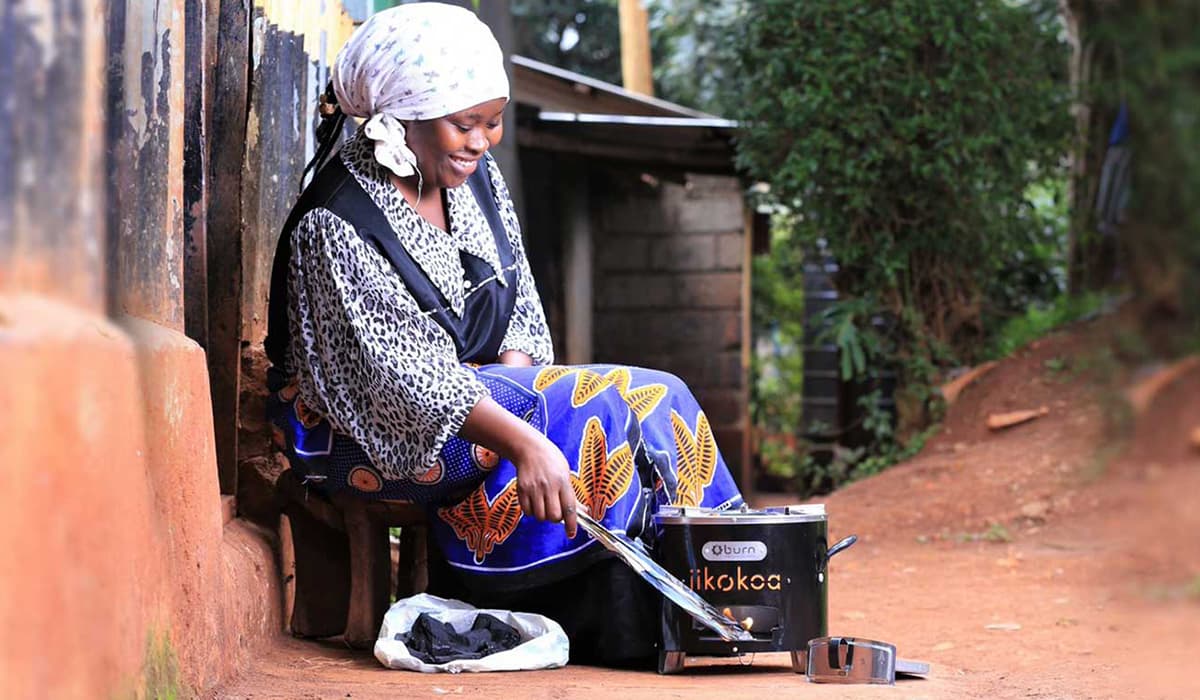
Reduced emissions, healthier families, and prosperous communities: a peer-reviewed independent RCT study of BURN’s clean cookstoves
“Credit, Attention, and Externalities in the Adoption of Energy Efficient Technologies by Low-Income Households”-By Susanna B. Berkouwer and Joshua T. Dean (October 2022)1
In 2019, an independent study of ECOA’s (formerly BURN) Jikokoa cookstoves was conducted by academics at the University of Pennsylvania, the Wharton School, and the University of Chicago. The cookstoves were studied in a Randomised Control Trial (RCT) experiment with 1,000 households across Nairobi, to test efficiency, savings, and barriers to adoption. This peer-reviewed study was published in the American Economic Review in 2022.
Three Key Findings
The Jikokoa cookstove was found to be the single best investment available for households in Kenya. Household spending on cooking fuel was significantly reduced with the Jikokoa, with finances reallocated toward food and education.
- An investment in a $40² ECOA’s (formerly BURN) Jikokoa yielded a 295% annual internal rate of return for each family.
- Charcoal spending was reduced by $2.28 per week, corresponding with a 39% decrease in charcoal consumption.³ Annual savings of $119 per year corresponded to a month of income on average.
- Respondents reported that the savings were used for critical household expenditures including:
- Food (50%)
- Child school fees (23%)
- Household items such as soap and clothes (17%)
- Families with a positive savings balance to start with, increased their savings by 75% over a year.
- The Jikokoa saved families an hour of cooking time per day on average.
- Considering the financial, health, and environmental benefits of the Jikokoa, each stove was estimated to generate over $1,000 in social benefits in the host country over three years.
- ECOA’s (formerly BURN) internal ex-ante engineering estimates for fuel efficiency savings were proved accurate in the field with a 95% confidence interval.
Long-Term Benefits
Health, financial and environmental benefits only increase with time – and systems are in place to ensure the longevity of the cookstoves.
- One year after the study, 98% of adopters still have their Jikokoa, and charcoal reductions are stable.
- Following two years of ownership, the most significant benefits found were financial savings, health improvements, and avoided greenhouse gas emissions.
- Adoption of the stove causes statistically significant improvements in health (with a standard deviation improvement of 0.5).
- The cookstoves were found to be easy to use and more durable than traditional cookstoves. Adopters also have access to free repair services provided in low-income areas across Nairobi.
Cost Remains a Barrier to Adoption
Despite awareness of the financial benefits of improved cookstoves, cost remains a barrier to adoption. This underlines the necessity of subsidising cookstove projects – either through carbon finance, government subsidies, or donor funding.
- Despite the significant financial returns presented by the Jikokoa, households are only willing to pay $12 for a $40 stove. This is despite awareness of the potential savings and benefits.
- Education and awareness interventions do not impact uptake, suggesting that the key barrier is cost.
- When given access to credit, willingness to pay more than doubles (to $25), suggesting households are significantly credit-constrained.
- However, credit doesn't close the gap to the $40 retail price, or solve adoption for the mass market.
- Policymakers cannot rely on households to adopt privately cost-saving energy efficient technologies themselves. Only subsidies that lower the upfront cost of adoption will allow low-income households to benefit from the advantages of energy-saving technologies like the Jikokoa.
- Every $1 of stove subsidy would generate $19 worth of environmental benefits and poverty alleviation.
References
1.American Economic Review 2022, 112(10): 1–40 https://doi.org/10.1257/aer.20210766
2.At the time of this study, ECOA’s (formerly BURN) Jikokoa retailed at $40. Now, with carbon investment, ECOA’s (formerly BURN) has halved the cost of charcoal stoves to consumers. Wood stoves have been subsidised further – to as little as $3–5.
3. Note that the study was conducted in 2019 on a previous version of ECOA’s (formerly BURN) charcoal stove. Our latest model is estimated to reduce fuel consumption by more than 60%.